
CRISPR Prime Editing Solutions
Precise substitutions, insertions, and deletions
Expand your editing possibilities with optimized prime editor mRNA, modified pegRNAs, and design support that streamline complex workflows, improve editing success, and accelerate precision editing programs from discovery to translational research
Ordering
Prime editing enables researchers to introduce targeted DNA substitutions, insertions, and deletions without requiring double-strand DNA breaks or donor DNA templates. Designed to support the next generation of genome engineering, IDT prime editing solutions combine optimized prime editor mRNA, chemically modified pegRNAs, design tools, and technical expertise to accelerate precision editing experiments.
- Create precise substitutions, insertions, and deletions from a single editing platform.
- Edit without double-strand DNA breaks or donor templates.
- Optimized by IDT scientists, PE Ultra mRNA delivers better editing activity compared to commercially available prime editor options, like PEmax.
- The proprietary chemical modification pattern used in Alt-R pegRNA is engineered to enhance stability and editing performance across targets and cell types.
- Integrated prime editing workflow with editor, guide RNA, design support, and genome editing expertise from a trusted CRISPR provider.
Alt-R™ pegRNAs
The IDT pegRNA design tool simplifies design and ordering of pegRNAs for targeted substitutions, insertions, and deletions. Alt-R pegRNAs are chemically modified and engineered for use with mRNA to improve stability, cellular performance, and editing efficiency, helping accelerate prime editing workflows.
Looking for single-base editing? Explore our Base Editing solutions.
Need Help?
Have questions for our CRISPR experts or need a custom solution? Your time is valuable and we’ll prioritize your inquiry. Click on “Request a consultation” to provide brief information about your project, and we’ll be in touch to discuss it ASAP.
Request a consultationProduct Details
Prime editing is a CRISPR-based genome editing modality that enables targeted DNA modifications without creating double-strand breaks or relying on donor DNA templates. Compared to traditional CRISPR-Cas9 editing, prime editing offers broader editing flexibility while reducing reliance on cellular DNA repair pathways
Prime editing utilizes:
- A prime editor enzyme
- A prime editing guide RNA (pegRNA) that includes a primer binding site (PBS), and reverse transcription template (RTT)
- Programmable editing instructions encoded directly within the RTT of the pegRNA
This approach enables:
- All base substitutions
- Small insertions
- Small deletions
- Combination edits
Unlike base editing, which is used to create specific nucleotide conversions, prime editing supports a broader range of genomic modifications. Click here for base editing solutions.
Why researchers choose prime editing:
Precision editing for translational research
As genome editing programs move closer to clinical application, researchers need editing technologies that can deliver precise genomic changes while minimizing unintended edits. Prime editing enables targeted substitutions, insertions, and deletions without requiring double-strand DNA breaks or donor DNA templates, offering a powerful approach for applications where precision and control are critical.
Streamline the path from discovery to translation
The combined IDT and Aldevron platform provides access to optimized prime editing reagents, highly modified guide RNAs, design support, and manufacturing expertise to help researchers move from early discovery through advanced translational research. By providing continuity across genome editing workflows, IDT helps simplify development while supporting future clinical ambitions.
Confidence through engineered performance
IDT prime editing solutions include an optimized prime editor mRNA and chemically modified pegRNAs designed to improve editing success and stability. Together with a free online design tool, these solutions help researchers spend less time troubleshooting complex workflows and more time generating actionable data.
Which editing approach is right for your application?
CRISPR-Cas9 editing, Base Editing, and Prime Editing represent complementary genome editing technologies, each using a distinct mechanism to introduce genetic changes. The table below provides an overview of the key steps in the editing process underlying each approach.
| CRISPR-Cas9 Editing | Base Editing | Prime Editing |
|---|---|---|
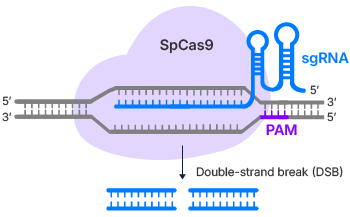 |
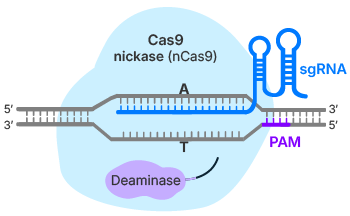 |
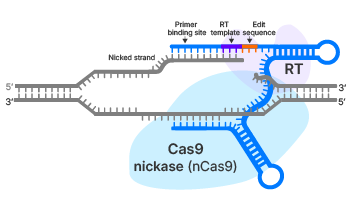 |
|
Mechanism:
|
Mechanism:
|
Mechanism:
|
| Feature | CRISPR-Cas9 | Base Editing | Prime Editing |
|---|---|---|---|
| Double-strand DNA break required |
Yes |
No |
No |
| Donor DNA template required |
Often required for precise insertions |
No |
No |
| Supported edit types |
Gene knockouts, insertions, and HDR-mediated modifications |
A→G and C→T base conversions |
All base substitutions, small insertions, and deletions |
| Editing precision |
Broad editing outcomes dependent on DNA repair pathways |
Highly precise single-base changes |
Precise sequence modifications with broad editing flexibility |
| Targeting flexibility |
Broad target accessibility |
Limited by editing window and PAM requirements |
Broad edit capabilities across many genomic loci |
| Genotoxicity considerations |
Higher due to double-strand break formation |
Lower due to absence of double-strand breaks |
Lower due to absence of double-strand breaks |
| Typical applications |
Gene knockout, gene insertion, functional genomics |
Precise nucleotide correction, disease modeling, translational research |
Disease mutation correction, precision engineering, translational research |
| Design complexity |
Relatively straightforward |
Moderate |
More complex due to pegRNA design requirements |
| Best used when |
Creating knockouts or introducing larger insertions |
Correcting specific point mutations with high precision |
Installing precise substitutions, insertions, or deletions without donor DNA |
Product Data
Comparison of editing efficiency of IDT’s PE Ultra mRNA to commercially available PEmax
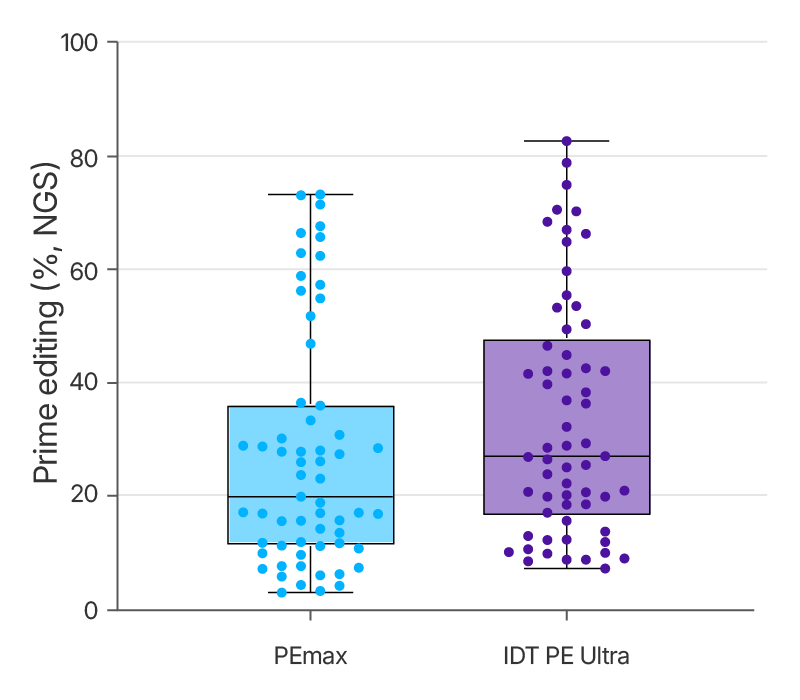
Figure 1. Editing efficiency of PE Ultra and PEmax in HEK293 cells. PE Ultra and PEmax mRNA and Alt-R pegRNA (6 µM) targeting a broad panel of sites (all 6 bp insertions) were delivered by nucleofection into HEK293 cells using the Lonza Nucleofection™ System. Genomic DNA (gDNA) was extracted 72 hours post nucleofection and editing was assessed by NGS.
PE Ultra mRNA and Alt-R pegRNA efficiently generate different mutation types across various immortal and primary cell lines
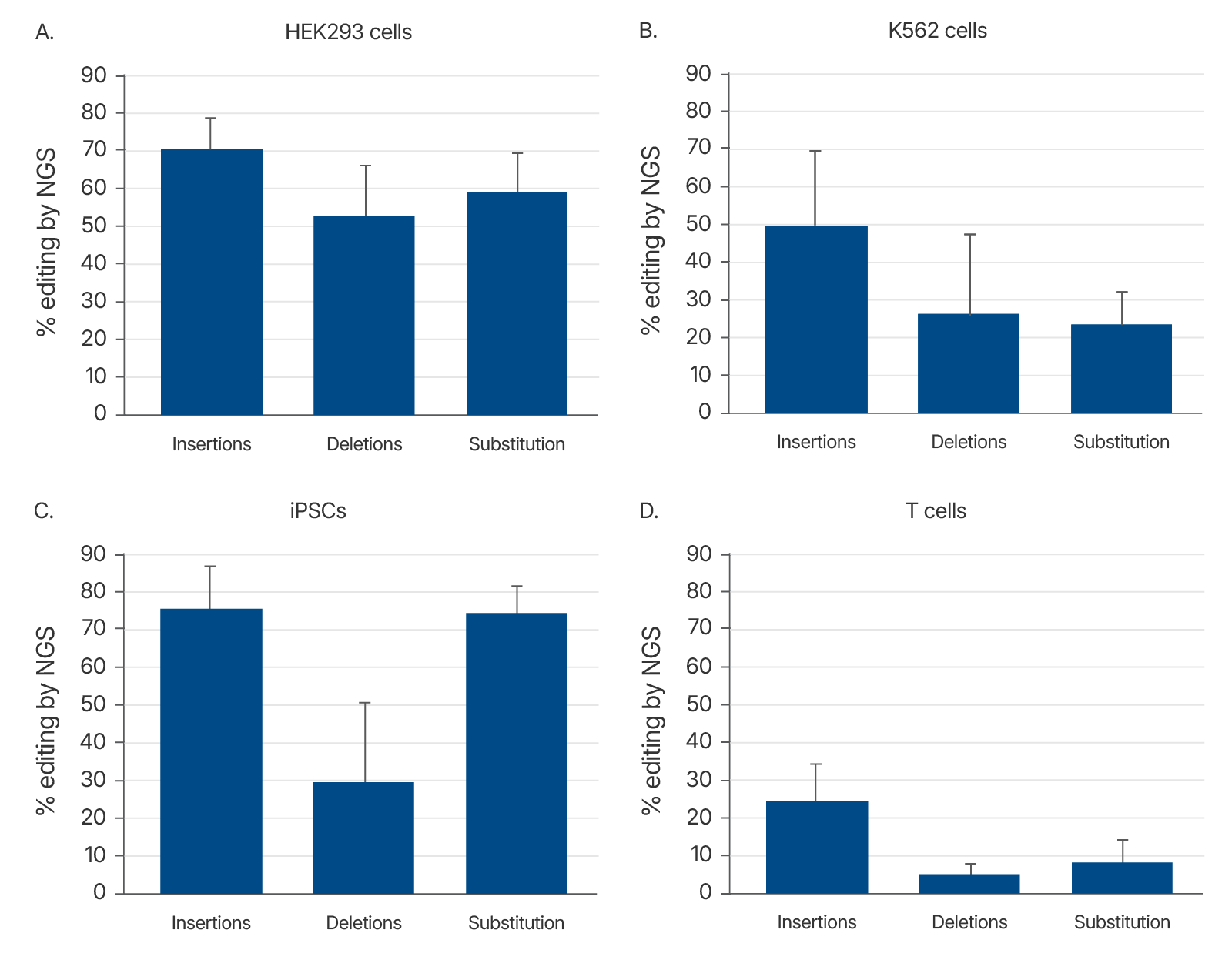
Figure 2. Editing efficiency of PE Ultra after nucleofection into multiple cell lines. PE Ultra mRNA, 6 uM Alt-R pegRNA and 2 uM nsgRNA targeting ACAT2, ADPGK, AK2, AGPAT1, FANCF and DMNT1 were delivered by nucleofection into HEK293 cells (A), K562 cells (B), iPSCs (C), and T cells (D) using the Lonza Nucleofection™ System. Genomic DNA (gDNA) was extracted 72 hours post nucleofection and editing was assessed by NGS. Edit types included insertions (3 bp: FANCF and DMNT1, 6 bp: ACAT2, ADPGK, AK2 and AGPAT1), deletions (all 3 bp) and SNP (all 1 bp). The data is the average of the 6 sites for each edit type, N=3.
Alt-R pegRNAs are modified and optimized for superior editing in primary cells via LNP delivery
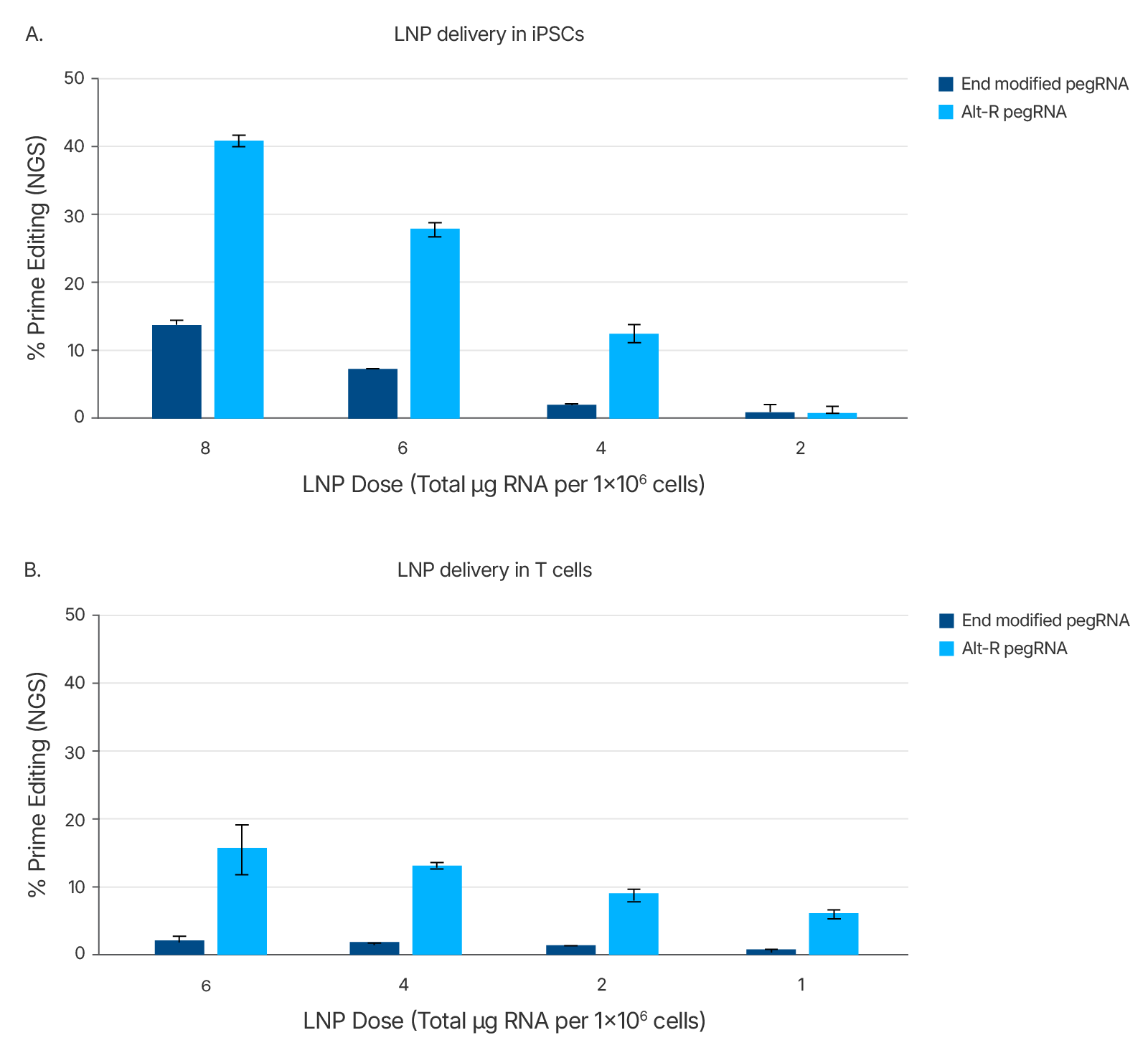
Figure 3. Alt-R pegRNAs are modified and optimized for superior editing in primary cells via LNP delivery. PE Ultra mRNA, Alt-R pegRNA, and ngRNAs were encapsulated into lipid nanoparticles (LNP) using the GenVoy-ILM™ T Cell Kit on the NanoAssemblr™ Spark instrument, following manufacturer’s instructions. Briefly, RNA working solutions were prepared in the supplied formulation buffer with mRNA, pegRNA, and nsgRNA mixed at a 6:5:1 ratio respectively by RNA weight. The lipid phase and RNA solution were then combined in the Spark instrument. Primary T cells were thawed and activated 72 hours prior to LNP addition. Cells were seeded at 0.5 x 10⁵ cells/well (iPSC, A), and 0.1 x 10⁶ cells/well (Primary T cells, B), followed by direct addition of the LNPs. Genomic DNA (gDNA) was extracted 72 hours post delivery and editing was assessed by NGS. pegRNAs were designed to introduce a 6 bp insertion at ADPGK. End modified pegRNA contains 3x 2’O-Methyl modifications and 3x phosphorothioate bonds on the 5’ and 3’ ends. (N=3)
Resources
Frequently asked questions
Do you have a protocol for prime editing?
We offer a prime editing protocol for electroporation workflows. This protocol can be found online in the "Resources" section of the Prime Editing product page.
What kind of edits can be performed with prime editing?
Prime editing is particularly well suited for base substitutions that are not accessible with base editors, as well as small insertions and deletions.
Which delivery method can be used for delivery of prime editor and pegRNA?
Our prime editing products are compatible with electroporation and LNP delivery. Additional delivery methods may be compatible, but we have not validated such methods.
How does prime editing differ from base editing or HDR-based CRISPR editing?
Base editing is the preferred approach for rapid and efficient correction of compatible single-base mutations, specifically C→T or A→G conversions. Prime editing is better suited for precise modifications beyond these transitions, including other base substitutions and small insertions or deletions, while avoiding the creation of double-strand DNA breaks. HDR-mediated CRISPR editing can also achieve substitutions, insertions, deletions, and even larger sequence replacements. However, HDR-based approaches generally exhibit lower editing efficiency and may carry a higher risk of off-target effects and genotoxicity.
How do I choose the spacer, reverse transcription template (RTT), and primer binding site (PBS)?
We offer a free configurator tool that generates suitable pegRNA sequences for screening based on your desired edit and target edit site.
What is the purpose of a nicking guide (ngRNA)?
The purpose of a nicking guide (ngRNA) is to introduce a nick in the non-edited DNA strand, encouraging cellular repair pathways to use the edited strand as a template for repair and thereby increasing prime editing efficiency.
What are the spacer, scaffold, primer binding site (PBS) and reverse transcription template (RTT) of a pegRNA?
The spacer is a 20-nt sequence that guides the prime editor to the target DNA site through base pairing. The scaffold forms the RNA structure required for prime editor complex assembly. The primer binding site (PBS) anneals to the nicked DNA strand and initiates reverse transcription. The reverse transcription template (RTT) contains the desired edit and serves as the template for reverse transcriptase to incorporate the edited sequence into the genome.
What components should be included when designing a prime editing guide RNA (pegRNA) for prime editing?
The key components of a pegRNA are the spacer, scaffold, primer binding site (PBS), and reverse transcription template (RTT).
What IDT products do I need to buy to perform prime editing?
Prime editor (PE) mRNA and prime editing prime guide RNA (pegRNA) are the basic components of any prime editing experiment. Please refer to our validated protocol in the Prime Editing "Resources" section for additional materials that may be needed.